Historic Documentation: High Street Commercial Corridor (Midtown Section)
Identification
Site Name: High Street Commercial Corridor
Location: Portion of High Street immediately east of Downtown Portsmouth
Neighborhood: Midtown Portsmouth / West High Street Corridor
Property Type: Mixed-use commercial corridor
Current Use: Retail, service businesses, entertainment establishments, industrial-related businesses, and vacant or underutilized commercial properties
Condition: Many residential buildings are well maintained and occupied, although numerous commercial buildings show signs of vacancy and deterioration
Overview
The area immediately east of downtown along High Street is considered the Midtown neighborhood of Portsmouth. Portsmouth Midtown emerged as a major social and retail hub following World War II. According to local newspaper accounts, residents often referred to Midtown as “the place,” and the area was widely viewed as a central destination for shopping and daily activity in Portsmouth. During this period, Midtown saw significant commercial development, including investment in shopping centers, grocery stores, and other retail establishments that drew customers from across the city.
However, Midtown, like many older urban retail areas, later experienced decline associated with suburbanization trends. Many businesses gradually relocated to nearby suburban areas such as Chesapeake and Virginia Beach, contributing to reduced commercial activity in the corridor. As a result, even though High Street sees large amounts of daily traffic, few people actually stopped to shop. These shifts weakened local retail base and impacted the city’s overall economy.
In response, the City of Portsmouth has worked with consultants, local business owners, and community leaders to develop plans to revitalize the corridor. These efforts have focused on encouraging reinvestment, reducing crime, and improving Midtown's public image amongst the residents of Portsmouth.
Historical Background and Analysis
According to Portsmouth city records, the first mention of High Street dates back to the city's founding in 1752. The founder, Col. William Crawford dedicated the four corners High Street and Court Street for a church, market, courthouse, and jail. In 1839, the ferry landing of Portsmouth changed from North Street to High Street. This was important as North Street was more residential while High Street was more commercial. By redirecting the landing place, it drew more potential customers and merchants into the city.
By the mid 20th century, High Street was vibrant cultural and entertainment hub with theaters, pubs, and sports halls. These venues served the thousands of workers from the nearby Norfolk Naval Shipyard. High Street Landing was later redeveloped and reopened in 1997 as a modern ferry terminal and docking facility, continuing its role as a transportation and waterfront access point. The Portsmouth Naval Shipyard Museum was also relocated to High Street, reinforcing its role as a civic and cultural destination.
Suburbanization after World War 2 led to the decline of the waterfront area of High Street. In the mid 20th century, Midtown considered a suburban neighborhood of Portsmouth. In 1952, the Elizabeth River (Downtown) Tunnel was built. Although it was meant to connect the suburban Midtown with downtown Portsmouth, the tunnel actually drained residents and commercial activity from Downtown. Midtown soon became the center of commerce for Portsmouth, and many residents saw it as an up-and-coming area. Midtown reached its peak when MidCity, the city's first shopping center, opened in 1959, which attracted even more shoppers from downtown.
However, Midtown began to decline for the same reasons it rose to prominence. Portsmouth's suburban sprawl soon extended beyond Midtown. Many stores soon began to move to nearby suburbs such as Chesapeake to Virginia Beach. According to old newspapers, older migrations describe the opening of Chesapeake Square Mall as a major turning point for Midtown's commercial dominance. As a result, Midtown became increasingly less of a primary shopping destination, even though thousands of vehicles still travel along High Street each day, with residents describing as a "racetrack" because of the thousands of commuters that drove through Midtown for the suburbs without stopping.
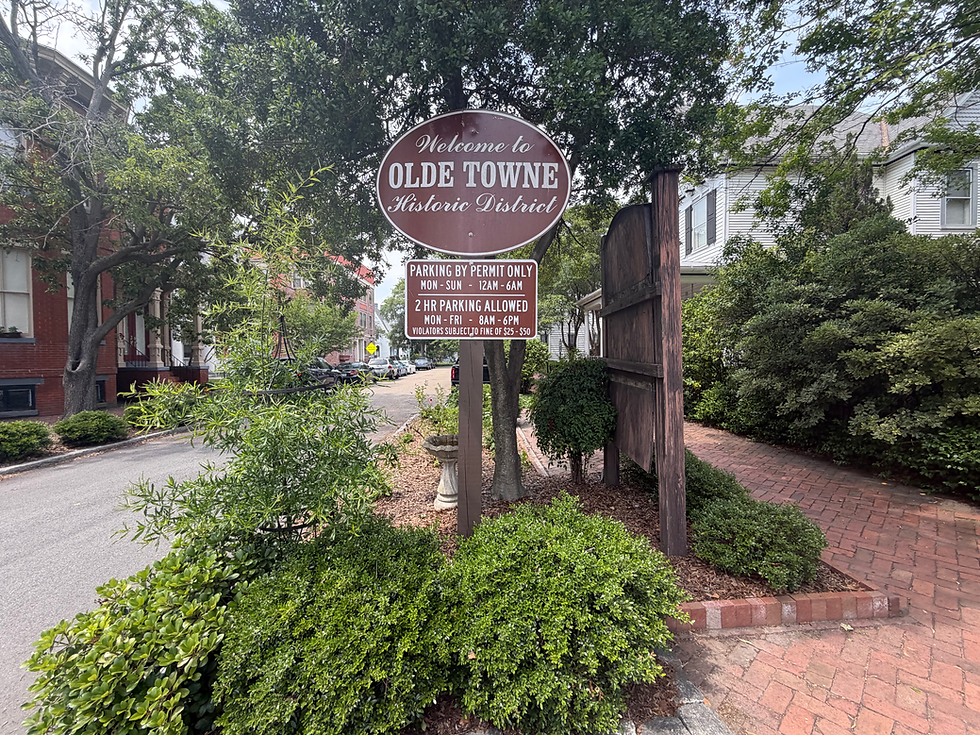
At the same time of Midtown's decline, the downtown portion of High Street was able to utilize its historic heritage for revitalization. In 1951, the city began using funding to clear blighted areas in downtown to begin building government offices and office towers. Later in 1970, the Olde Town Historic District was established to preserve and transform the 18th and 19th century buildings into historic landmarks. These policies allowed Downtown to establish a stable employee and tourism base that Midtown lacked. Conversely, Midtown was caught in a awkward situation. It was no longer a booming suburb, yet it was not old enough for historic preservation. Furthermore, the mid-century stores were considered too small for the new suburban style supermarket chains. These factors led to further decline of Midtown as it became increasingly unattractive to shoppers. Due to its lack of historic status, city consultants actually recommended to raze portions of Midtown to build residential neighborhoods, a plan that was stopped after pushback from local business owners.
The perception of Midtown has begun to shift in recent years. The city expanded its historically significant timeframe to include the mid-century modern period (1951–1974), officially acknowledging Midtown as an important part of Portsmouth's history. Now, instead of razing the area, the city is now designating it as a Innovation District with aims to transition it into a more walkable and creative district.
Recent developments for Midtown have been a 200,000 square foot Super Center opening and a $19.3 million-dollar federal grant for roadway redesign and upgrades aimed to improve safety, walkability, and long-term economic activity.
Field Observations/Condition Assessment
Many of the small boutique style stores are abandoned
A couple of homeless people were observed sleeping on the store steps, with belongs scattered onto the sidewalk
Several shop windows boarded up, likely to prevent theft and protect the interior of the buildings
Side walls of shops show fading paint and discoloration
Some brick walls have missing bricks and signs of erosion
Certain buildings appear to have had paint or graffiti on their side walls, as bright colors not normally found in brickwork remain visible.
Graffiti seen on the windows of several stores
Some windows have rusting steel bars that were likely used for security purposes, although condition shows long term neglect
Numerous properties show signs of vacancy, deterioration, and lack of maintenance.
Timeline of Events
Year | Event |
1752 | Portsmouth is founded by Colonel William Crawford who establishes High Street as the commercial spine of the town |
1839 | Ferry landing moved from North Street to High Street, redirecting potential customers into the city's commercial district |
1952 | Elizabeth River (Downtown) Tunnel opens, increasing connectivity but draining residents from city's core |
1940s-1950s | Downtown portion of High Street begins to decline due to suburbanization |
1959 | MidCity Shopping Center, Portsmouth's first shopping center, is opened, marking Midtown's peak as Portsmouth's retail hub. |
1961 | The Portsmouth Federal Building opens on High Street, signaling the first step in the revitalization of the waterfront area |
1970 | Olde Towne Historic District is listed on the National Register of Historic Places, allowing Downtown to pivot into a tourism and entertainment-based economy |
1980s | Midtown begins to decline due to suburbanization trends pushing businesses out into Chesapeake and Virginia Beach |
1989 | Opening of Chesapeake Square Mall, dealing a significant blow to Midtown |
2022 | Federal grant of $19.3 million aimed to redevelop Midtown into a walkable district |
2026 | City officially recognizes Midtown as a historic district |
References
Complete High Street Innovation Corridor. (2024). Portsmouthva.gov. https://www.portsmouthva.gov/2376/Complete-High-Street-Innovation-Corridor
Daniel, E. (2024, September 13). Portsmouth to designate stretch of High Street as new “Innovation District.” 13newsnow.com. https://www.13newsnow.com/article/news/local/mycity/portsmouth/portsmouth-leaders-agree-to-designate-uptown-area-as-citys-innovation-district/291-98e1dab8-75fa-4e62-8edb-cbf67b49e63b
History of Portsmouth Timeline | Portsmouth Tourism. (2024, February 27). Portsmouth Tourism. https://portsvacation.com/portsmouth-history-timeline/
jessie@itsrocketbike.com. (2020, March 22). NIGHTLIFE | Portsmouth Tourism. Portsmouth Tourism. https://portsvacation.com/nightlife/
MEMORANDUM OF AGREEMENT BETWEEN THE CITY OF PORTSMOUTH, VIRGINIA, THE PORTSMOUTH REDEVELOPMENT AND HOUSING AUTHORITY, AND THE VIRGINIA STATE HISTORIC PRESERVATION OFFICE (SHPO) REGARDING 1020 HIGH STREET. (n.d.). Retrieved June 12, 2026, from https://www.hudexchange.info/sites/onecpd/assets/File/va-portsmouth-2013a-MOA%20-Section-106.pdf
MIDTOWN AT MIDDLE AGE. (2026). Vt.edu. https://scholar.lib.vt.edu/VA-news/VA-Pilot/issues/1994/vp941007/10060197.htm
NATIONAL REGISTER OF HISTORIC PLACES REGISTRATION FORM. (n.d.). Retrieved June 12, 2026, from https://www.dhr.virginia.gov/VLR_to_transfer/PDFNoms/124-5063_Downtown_Portsmouth_HD_2002_Final_Nomination.pdf
National Register of Historic Places Registration Form. (n.d.). Retrieved June 12, 2026, from https://www.dhr.virginia.gov/wp-content/uploads/2026/05/124-5286_Downtown_Portsmouth_HD_BI_2026_NR_DRAFT_WEB.pdf
Parallel Midtown Tunnel / Pinners Point Interchange / Martin Luther King Freeway Extension. (2016). Roadstothefuture.com. https://www.roadstothefuture.com/Mid_Tunn_Port_Norf_MLK.html
Portsmouth - Redevelopment and Housing Authority. (2026). Prha.org. https://www.prha.org/redevelopment/project_gallery.php
Portsmouth History | Portsmouth, VA. (n.d.). Www.portsmouthva.gov. https://www.portsmouthva.gov/485/Portsmouth-History
RODMAN’S BONES AND BUDDY’S MEANS BARBECUE TO THE LOCALS. (2026). Vt.edu. https://scholar.lib.vt.edu/VA-news/VA-Pilot/issues/1996/vp961020/10180267.htm
Virginia Department of Historical Resources. (12 C.E.). Downtown Portsmouth Historic District Boundary Increase___________. https://www.dhr.virginia.gov/wp-content/uploads/2025/02/124-5286_Downtown_Portsmouth_HD_BI_2025_PIF_for_WEB.pdf


Comments